
|
|
CHARLES II
(1630-1685). King of England, Scotland and Ireland.
Email about this entry
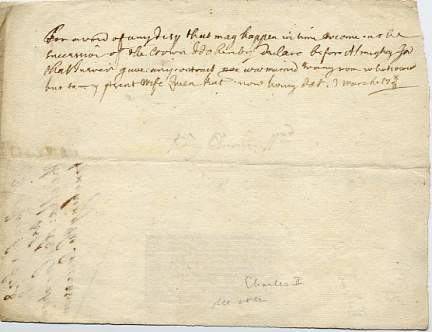
Historically significant autograph declaration (unsigned), regarding the royal succession, four lines on 1 page 4to, 3 March 1678/9. A contemporary endorsement to the verso ('3 March 1678/9 His Maties declaration touching the Succession') and with an old catalogue description lightly attached. The document, in which the king denies under oath that he has never been married to any woman apart from his present queen, 'Kat' [i.e. Catherine of Braganza] shows every sign of having been hastily written perhaps under some duress. 'For avoid[ance] of any disp[ute] that may happen in time to come in the succession of the Crown I do hereby declare before Almighty God that I never gave any contract nor was married to any wom[an] whatsoever but to my present Wife Queen Kat. now being dat[ed] 3 March 1678/9' The emergence of the Exclusion movement in the wake of the Popish Plot compels the King to declare unambiguously the illegitimacy of the Duke of Monmouth's claim to the throne. Written three days before the opening of the new parliament in 1679, this document represents a vital part of the King's defence against the escalating whig propaganda campaign to exclude the Catholic James, Duke of York, from the succession. Rumours were rife that Charles would declare his son, the Duke of Monmouth, legitimate. Earlier in 1679 the King had made a statement to four of his councillors that these were unfounded, and on 3 March he repeated this solemn statement to the entire Privy Council, having written it out in his own hand and signed it. He ordered this signed document to be kept in the Council chest; it is now in the Pierpont Morgan Library in New York. The present document differs only slightly in its wording (in particular 'now being' for 'now living' at the end, which may be a misreading in one or other document of the king's awkward hand). This could therefore be a draft for this final, signed, version (which would explain the lack of a signature). In spite of this declaration, by the summer of 1680 rumours concerning the Duke of Monmouth's legitimacy escalated, the central story being construed from allegations by dubious witnesses that Dr John Cosin, later Bishop of Durham, had conducted a wedding ceremony in Paris in 1650 between Charles and Lucy Walter, the Duke of Monmouth's mother, and that the marriage certificate had been hidden in a black box. This box was never found, but the persistence of the rumours led Charles to order a version of his declaration to the Privy Council to be printed in the London Gazette for 8 June 1680. £4500 [No: 25972] |