
|
|
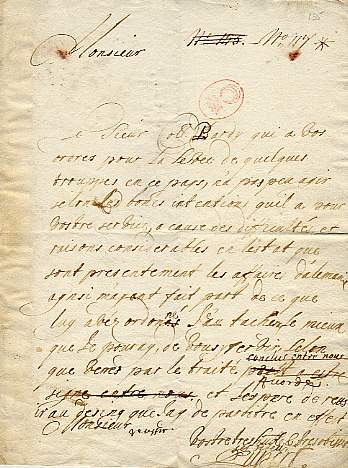
RUPERT, Prince (1619-1682). Royalist general. Son of Elizabeth of Bohemia. Letter Signed to an unnamed correspondent, in French, 1 page 4to, with light collection stamps and later endorsements, no place, no date, [1655]. Together with a later notarial copy of Prince Rupert's will. '... Colonel Pardy, who has your orders to raise some troops in this country, has been unable to fulfil the good intentions which he has to serve you, on account of the difficulties and reasons of state created at present by the affairs of Germany. Since he has told me what you ordered him to do, I will try my best to serve you in this matter according to the treaty [concluded between us / drawn up for signature between us (both deleted)] ... and I hope to succeed in the designs which I have drawn up for myself. ... Your very humble and obedient servant, Rupert.'Perhaps a retained version, as it has small alterations in two hands. The word 'Accordé' is apparently intended to concur with a small change, but rather oddly the word 'reussir' is written out again, perhaps because it originally spanned two lines and may have been difficult to interpret. This letter, probably addressed to Duke Francis I of Modena from the court of Rupert's brother, the Prince Palatine, Charles Louis, in Heidelberg, apparently refers to Rupert's undertaking in the spring of 1655 to raise troops in the German states to use on behalf of Modena against the Spanish rule in Milan. Colonel Pardi, the Modenese ambassador at Heidelberg, drew up a solemn agreement to this effect with Rupert, which both parties signed on 17 April. This letter, therefore, was evidently written in early April to inform Duke Francis of the tentative agreement between his ambassador and Rupert. In the event, Rupert found that the depletion of manpower in Germany resulting from the Thirty Years' War made recruitment more difficult than he had foreseen; while the French would not allow him, as a foreigner, to command French auxiliary troops for another prince. Having been invited to serve King Charles II, Rupert withdrew from his obligation towards Modena, justifying himself both on the grounds that Francis had ostensibly wished to use the troops only for defence against the Papal States and in protest against Francis's offer to command the French troops himself. See Patrick Morrah, Prince Rupert of the Rhine (1976), 291-292. [No: 23333]
| |