 'My victory would have been very dearly purchased'
WOLSELEY, Garnet Joseph, Viscount
(1833-1913). Field Marshal.
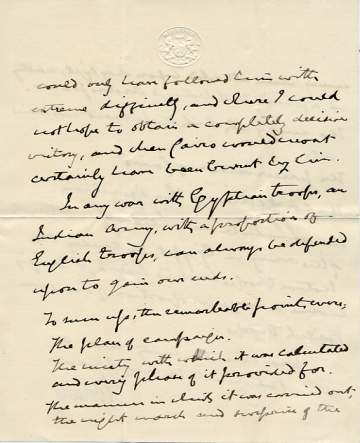
Highly important Autograph Letter Signed to Lord Reay, 6 pages 4to, War Office, 13 February 1883. Describing in great detail and justifying every move in his recent campaign against Arabi Pasha in Egypt.
The background to this historically most interesting letter is succinctly stated in the Dictionary of Naitonal Biography: 'In 1882 Arabi Pasha headed a rebellion of the Egyptian army, and on France's refusal to intervene, the British government took the law into its own hands and sent Wolseley to enforce it. After a futile naval bombardment of Alexandria, which Wolseley condemned, there followed a short and brilliant military campaign. Wolseley left England on 15 August, and after a feint at Alexandria, swiftly and secretly transferred his troops down the Suez Canal to Ismailia. A sharp action at Kassassin brought him before Arabi's fortified lines at Tel-el-Kebir, and these were carried on 13 September by a night attack, a more daring enterprise at that date than it sounds to-day. Arabi's force was routed, and Cairo promptly occupied. For this achievement Wolseley was promoted general, received the thanks of parliament, a grant of £30,000, and was created Baron Wolseley, of Cairo and Wolseley.' '... [The campaign's] most salient features were its completeness: having designed the plan of campaign I never changed it in any way. The march upon Cairo was planned, even in it's minute details when on board ship going out: I had with me the General officer - Drury Lowe and his principal Staff Officer, Colonel Herbert Stewart (now with Lord Spencer in Ireland) and to them I indicated fully all I wanted done, and they carried my plans out most ably - as we had ruined Alexandria, my great desire was to save Cairo from a similar fate, & all my plans and movements during the war made with this great object in view.
For every reason, political as well as military and sanitary, it was essential to make the campaign as short as possible, but at the same time I was determined not to make my final rush upon Cairo until I had everything ready & complete to make an end to the war. After the attack of the enemy on the 9th September at Kassassin had been repulsed, there were many in my camp who wished me as they termed it, "to follow up" my momentary success. This is the sort of advice that weak men take, & that so frequently lands an army in failure or even if it does not do this, leads only to very partial success. I was determined to wait until I could take my enemy by the throat, and when I had him in my grasp to strangle him & pursue my advantage by a rapid advance of all my cavalry upon Cairo. My calculations were all laid beforehand and made for this advance to take place on the 13th Septr. and I held to my plan. I kept my plan secret that I meant to attack during the dark until the last moment. It was the most novel feature in the war: the operation stands by itself in this respect, and I think it was one that few would have dared to attempt. I never doubted it's success, and I knew that I should save a least a thousand in killed & wounded by it's means. Had I attempted to attack the enemy at Tel el Kebir by daylight in the ordinary hum-drum and conventional method, I have no doubt I should have succeeded, by my victory would have been very dearly purchased, and it could not have been the complete success it was by surprising the enemy.
Arabi & his army were taken completely by surprise, and panic was the result. His military power was destroyed by that surprise; had I attacked by daylight he would have had hours of warning & might have drawn off his army into the cultivated country of the Delta, where I could only have followed him with extreme difficulty, and where I could not hope to obtain a completely decisive victory, and when Cairo would most certainly have been burnt by him.
In any war with Egyptian troops, an Indian Army, with a proportion of English troops, can always be depended upon to gain our ends.
To sum up, the remarkable points were the plan of campaign. The nicety with which it was calculation and every phase of it provided for. The manner in which it was carried out, the night march and surprise of the enemy when attacked before daylight, resulting in a panic that destroyed Arabi's power. The enemy with which the pursuit was carried out.
The preservation of Cairo.
The completeness of the operation.
The immediate reduction of the strength of the army in Egypt, by sending the native troops back to India, & bringing home a large proportion of our own British troops. ...' Together with a second Autograph Letter Signed from Wolseley to Lord Reay, 4 pages 8vo on black-edged paper, War Office, 29 January 1884, regarding the wearing of the 'bonnet' by highland regiments, and putting forward the arguments for and against.
[No: 21082]
The image is of one page of the first letter only.
|
